Lean Six Sigma White Belt

Learners

Modules

Hours

Online

Access

Course Overview

The Lean Six Sigma White Belt – Online course is a practical introduction to process improvement for professionals at any level.
This self-paced program explains how Lean Six Sigma works in real organizations, introducing key concepts, terminology, and tools used to eliminate waste, improve processes, and deliver value. It is designed to help learners quickly understand the improvement mindset and contribute effectively to team-based initiatives.

Empty space, drag to resize

Learning Objectives

By the end of this course, participants will be able to:

  • Understand Lean Six Sigma principles, roles, and terminology
  • Recognize improvement opportunities in everyday processes
  • Apply the DMAIC framework at a foundational level
  • Identify waste and inefficiencies using structured tools
  • Support improvement projects within your organization


Who should attend

This course is ideal for: 
  • Professionals seeking a first introduction to Lean Six Sigma
  • Employees supporting improvement or transformation initiatives
  • Team members working with Green Belts or Black Belts
  • Graduates and early-career professionals building process excellence foundations
  • Anyone looking for a quick, structured overview of Lean Six Sigma fundamentals

Curriculum Highlights

The course consists of 13 structured modules, supported by quizzes and exercises:

01

Introduction to Lean Six Sigma

Appropriate for all levels of the organization, this introductory course provides a high-level overview of the fundamental concepts of Lean Six Sigma. It describes the Lean Six Sigma methodology, the role of a Lean Six Sigma Belt, and what it takes to create a successful Lean Six Sigma culture.

02

Introduction to Lean

This introductory course provides a high-level, interactive overview of the fundamental concepts of Lean, including the elimination of organizational waste and the identification of value add activities.

03

The Five Principles of Lean

This module explores the five Principles of Lean: Value, Value Stream Map, Flow, Pull and Strive for Perfect.

04

Six Sigma Literally Speaking

This course explores the meaning behind the phrase "Six Sigma". It illustrates how Six Sigma can be put to practical use inside an organization to affect change, and describes the fundamental concept of variation. In addition, the course explores the cost of poor quality to an organization.

05

Six Sigma Roles and Phases

Designed for executives and managers, this course describes the key roles individuals play during the phases of the Six Sigma process. Every individual responsible for deploying Six Sigma within an organization should view this course.

06

DMAIC for Teams

This course examines team member responsibilities and project objectives in each phase of the Lean Six Sigma process. It is designed specifically for individuals who will be participating on a Lean Six Sigma project team.

07

5S

5S is a Lean method designed to eliminate waste by establishing a place for everything and putting everything in its place. The five S’s represent Sorting, Storing, Shining, Standardizing and Sustaining. Each of these activities is carefully explained during this course so that students understand what 5S is or is not, as well as the benefits of 5S. Examples and an interactive simulation help illustrate 5S in the workplace.

08

The Eight Types of Waste

This course explains why eliminating waste (non-value-added activities) relates directly to the five principles of Lean. In addition to learning how to identify each type of waste, students will discover the three rules of waste and the three key questions that define value. A helpful acronym for recalling the eight types of waste enhances retention; real world examples and checkpoints aid comprehension.

09

Fishbone Diagrams

This module introduces the Fishbone Diagram, its purpose, and its application. It also explains how to construct a Fishbone Diagram.

10

Building a C&E Matrix

This course describes how to build and analyze a cause and effect matrix, or “C&E Matrix.” The C&E matrix links the critical-to-quality aspects of a process to the previously identified causes and effects. It is a very useful tool for prioritizing the factors that have the highest impact on customer satisfaction, and choosing the correct factors that require further measurement.

11

Generating Solution Ideas

In this course, students will learn a variety of tools used to produce solutions aimed at reducing the effects of root cause issues. Techniques explored include brainstorming, benchmarking, open innovation, and biomimicry. Students will also learn how to group and clarify ideas in preparation for evaluating solutions.

12

Control Methods

The purpose of control methods is to reduce the potential for any defect to occur. This module will review Countermeasures, Flags, SPC, Inspection, SOPs and Warning Signals and rate their ability to detect and prevent defects.

13

Project Closure

Effectively driving projects to closure is critical to sustaining long-term Lean Six Sigma gains. This course details the key steps to successful project closure.

Certification

Empty space, drag to resize
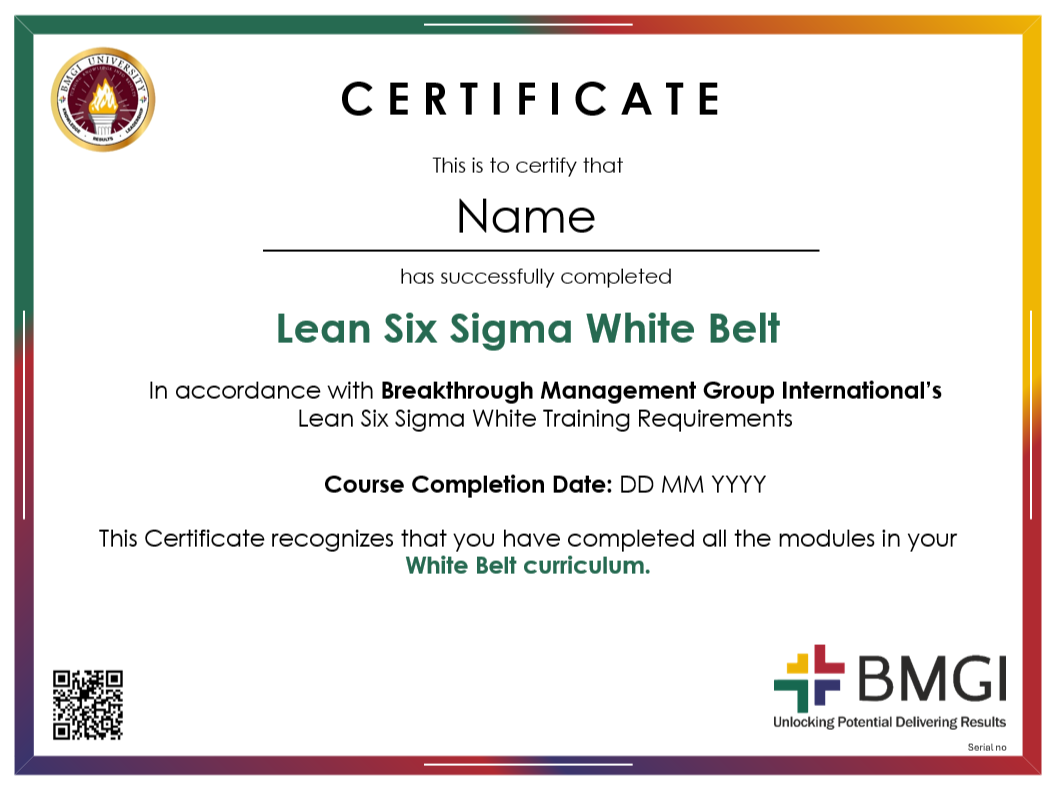
  •  Course Completion Certificate

    Awarded upon successful completion of all modules, quizzes, and exercises
Empty space, drag to resize

Why BMGI?

BMGI is a global leader in process improvement and Lean Six Sigma capability building. Trusted by organizations worldwide. BMGI combines consulting expertise with practical training to help professionals understand processes deeply and drive meaningful, sustainable improvement. 

Never miss the news

Stay updated | Stay current | Stay connected

Thank you!

Course Modules